
 Français
  Deutsch
  Español
  Italiano
  Nederlands
  Português
  Brasileiro
  Ελληνικά
  Polski
  Română
  Svenska
  Türkçe
  Български
  हिंदी
हिंदी 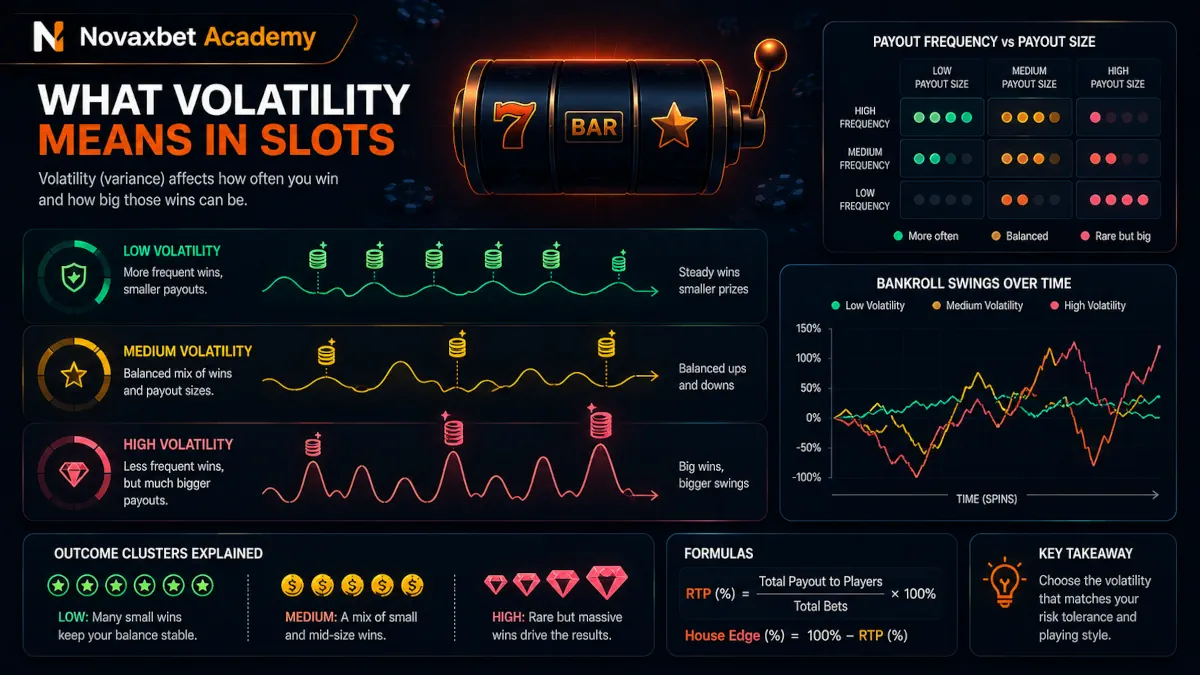
What Volatility Means in Slots
Understanding slot volatility and how payout frequency differs from payout size.
Novaxbet Editorial •2026-06-04•7 min read
Slot volatility is one of the most important concepts in casino games, but it is also one of the most misunderstood. Many players assume volatility means “good” or “bad” slots. In reality, volatility describes how wins are distributed over time, not whether a game is fair or unfair.
This article explains what volatility means in slots, how it differs from RTP, how it shapes session experience, and how players can use it to choose games that match their risk tolerance.
Core Definition: What Volatility Actually Means
Next reading
In slots, volatility (also called variance) describes the pattern of payouts:
- how often wins tend to occur,
- how large wins tend to be,
- how uneven the bankroll path can feel during a session.
A practical one-line definition:
- Low volatility = more frequent, usually smaller wins.
- High volatility = less frequent wins, but potentially larger payouts.
Volatility is about distribution shape, not guaranteed outcomes. A high-volatility slot does not promise a big win. A low-volatility slot does not promise profit.
Volatility vs RTP: Different Questions
Players often mix these two metrics, but they answer different questions.
| Metric | Main Question | What It Describes |
|---|---|---|
| RTP | “How much comes back in the long run?” | Average long-run expected return |
| Volatility | “How bumpy is the path?” | Frequency and size pattern of wins |
Two slots can both have 96% RTP and still feel completely different. One may pay small amounts often, while the other may produce long dry spells and occasional big hits.
So:
- RTP = expected long-run cost rate.
- Volatility = session experience pattern.
Both are needed for a realistic understanding.
Three Practical Volatility Profiles
Low Volatility Slots
Typical behavior:
- Wins appear relatively often.
- Most wins are small relative to stake.
- Bankroll swings are usually smoother.
Common player experience:
- Longer sessions per bankroll unit.
- Lower emotional extremes.
- Fewer very large single-hit outcomes.
Low volatility can feel “stable,” but it still includes losing sessions.
Medium Volatility Slots
Typical behavior:
- Balanced mix of hit frequency and hit size.
- Moderate swings.
- Combination of base-game wins and occasional stronger features.
Common player experience:
- More varied results than low volatility.
- Less extreme droughts than high volatility (on average).
- Flexible choice for players who want balance.
High Volatility Slots
Typical behavior:
- Longer no-win or low-win stretches can occur.
- Value is often concentrated in rarer events (bonus rounds, multipliers, premium symbol combinations).
- Large swings are common.
Common player experience:
- Higher short-session risk.
- Greater emotional variance.
- Occasional large payouts, but no guarantee.
High volatility is not “better.” It is simply a higher-variance payout profile.
Why Volatility Feels So Different in Real Play
The human brain notices streaks more than averages. That is why volatility has such a strong practical impact.
With low volatility, players may see frequent feedback (small wins), which can make a session feel active. With high volatility, long stretches without meaningful wins can feel frustrating—even if the same game can also produce standout events.
This does not contradict math. It reflects two realities existing together:
- Long-run expectation (RTP).
- Short-run distribution noise (volatility).
Session satisfaction is often driven more by point #2 than by point #1.
Example: Same RTP, Different Volatility
Assume two hypothetical slots, each with 96% RTP.
| Slot | RTP | Volatility | Typical Pattern |
|---|---|---|---|
| Slot A | 96% | Low | Many small returns, fewer deep drops |
| Slot B | 96% | High | Longer droughts, occasional large spikes |
Even with equal RTP:
- Player on Slot A may experience slower bankroll erosion.
- Player on Slot B may experience sharper drawdowns and rare strong recoveries.
Over very large sample sizes, both can trend toward similar expected return. Over short or medium sessions, results and emotional experience can diverge heavily.
Where Volatility Comes From in Slot Design
Volatility is shaped by game math and feature architecture, including:
- symbol weighting,
- paytable structure,
- hit frequency,
- bonus trigger probability,
- multiplier distribution,
- concentration of value in rare combinations.
Two key design choices often drive volatility upward:
- Rarer but more valuable events (e.g., premium symbols or large multipliers).
- Bonus value concentration (a larger share of total RTP stored in less frequent bonus outcomes).
When base-game payouts are smaller and bonus events carry more of the return, sessions can become much swingier.
Bonus Features and Their Volatility Impact
Bonus mechanics can significantly alter perceived volatility.
Common examples:
- Free spins with multipliers,
- Pick-and-win bonus rounds,
- Expanding wild features,
- Retrigger systems,
- Progressive or must-hit style jackpots.
Important nuance:
- A slot can advertise rich bonus potential,
- yet bonus entry can be infrequent,
- and many sessions may end before strong bonus outcomes appear.
So “big feature potential” usually implies higher variance in practical outcomes.
Misconceptions About Slot Volatility
Misconception 1: “High volatility means higher RTP.”
Correction: Volatility and RTP are different parameters. A high-volatility slot can have lower, equal, or higher RTP than another slot.
Misconception 2: “Low volatility means safe profit.”
Correction: Low volatility generally means smoother payouts, not guaranteed positive sessions. The game can still produce losses.
Misconception 3: “After many losses, a high-volatility slot is due.”
Correction: In compliant RNG systems, spins are independent. Past outcomes do not force immediate compensation.
Misconception 4: “Volatility labels predict my session.”
Correction: Labels describe tendency, not certainty. Any single session can deviate strongly from average behavior.
How to Use Volatility When Choosing a Slot
A practical framework:
- Check the game’s RTP and volatility description.
- Decide your session objective:
- longer entertainment pace,
- balanced experience,
- or acceptance of larger swings for larger-hit potential.
- Choose stake size relative to volatility (higher volatility usually needs more conservative staking).
- Set a fixed budget and session limit before starting.
- Reassess if actual experience does not match your risk comfort.
Volatility is most useful when combined with bankroll discipline. Without limits, even “good choices” can lead to poor outcomes.
Bankroll Planning by Volatility Profile
This is not a guarantee model, but a planning orientation.
| Volatility Profile | Typical Session Behavior | Practical Planning Bias |
|---|---|---|
| Low | More frequent small feedback | Longer session pacing focus |
| Medium | Mixed rhythm and swing | Balanced pacing and upside focus |
| High | Larger variance and drought risk | Tighter stake control, fewer rounds expected |
General planning principle:
- The higher the volatility, the more important it is to reduce stake size and enforce hard stop limits.
That does not eliminate risk. It only improves control over downside during normal variance.
Support-Team Interpretation (Operational Use)
Volatility language is useful in player support conversations, especially when users report:
- “This game suddenly stopped paying.”
- “I played many spins and got nothing significant.”
- “The game must be blocked for me.”
Support responses should be clear and neutral:
- explain that volatility affects payout rhythm,
- distinguish frequency from fairness,
- remind that short sessions can vary,
- avoid guaranteeing future outcomes.
Escalation should focus on technical evidence (malfunction signals, settlement mismatches), not normal variance alone.
Responsible Play Context
Understanding volatility can reduce frustration-driven decisions. High-volatility sessions can trigger “chasing” behavior after long dry spells.
Recommended controls:
- pre-set budget,
- fixed time cap,
- stop-loss and stop-win boundaries,
- breaks after high-emotion streaks.
Volatility awareness is not just math literacy. It is a practical responsible-play tool.
Closing Summary
Slot volatility explains the shape of results, not the fairness of results. RTP explains long-run expected return; volatility explains short-run payout behavior.
If players treat volatility correctly, they can make better game-selection decisions:
- choose smoother or swingier profiles intentionally,
- set stakes that match the profile,
- avoid false expectations about “due” outcomes,
- and keep session control through disciplined limits.
In simple terms:
- RTP tells you the long-run average.
- Volatility tells you how rough the ride can feel.
Both matter. Using both together creates a more realistic and responsible understanding of slot gameplay.