
 Français
  Deutsch
  Español
  Italiano
  Nederlands
  Português
  Brasileiro
  Ελληνικά
  Polski
  Română
  Svenska
  Türkçe
  Български
  हिंदी
हिंदी 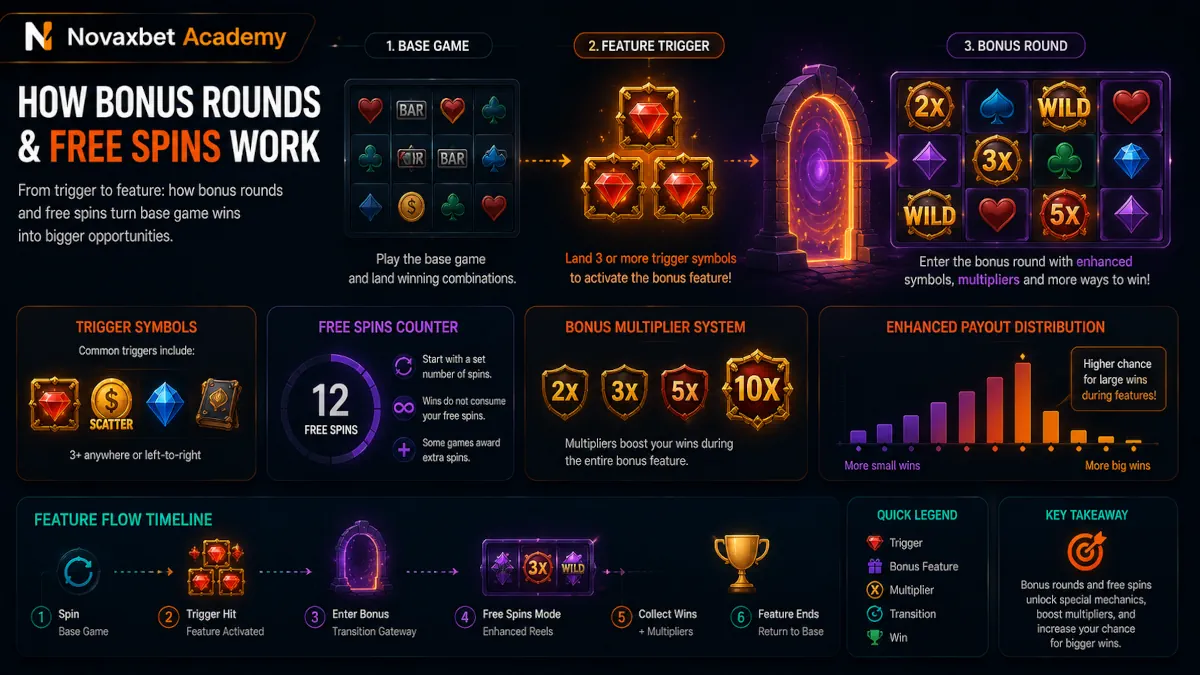
How Bonus Rounds and Free Spins Work
Explanation of common slot bonus mechanics, triggers, and payout effects.
Novaxbet Editorial •2026-07-01•6 min read
Bonus rounds and free spins are among the most visible mechanics in modern slot games. They change how a session feels, how payouts are distributed, and how players interpret short-term results. To use them responsibly, it helps to understand what they are, how they are triggered, and what they can (and cannot) change in the long run.
This guide explains bonus rounds and free spins in practical terms: trigger logic, feature structures, payout impact, and common misunderstandings.
What Are Bonus Rounds and Free Spins?
Next reading
In slot design, a base game is the standard spin cycle, while features are special modes that run under predefined rules. Two of the most common features are:
- Free spins: a sequence of spins where no additional stake is deducted per spin once the feature is active.
- Bonus rounds: separate mini-game or enhanced-mode phases with distinct payout rules.
Both are part of the game's math model from the start. They are not manual interventions and they are not triggered by “operator decisions” during your session.
How Feature Triggers Usually Work
A trigger condition is coded into the game and checked on every spin. Common trigger models include:
- landing a required number of scatter symbols,
- collecting feature symbols over multiple spins,
- filling a progress meter,
- hitting specific combinations on designated reels.
When the trigger condition is satisfied, the game moves to the feature state automatically.
Important point about rarity
If a feature is powerful (for example, high multiplier potential), it is usually designed to trigger less often. If a feature triggers frequently, average feature value is often lower. This trade-off is part of volatility design.
Free Spins: The Core Structure
Most free-spin features follow a simple framework:
- Trigger: the base game activates free spins.
- Award size: the game grants a fixed number of free spins (for example, 8, 10, or 12).
- Feature rules: special rules may apply (sticky wilds, multipliers, expanding symbols, etc.).
- Resolution: all awarded spins complete; total feature payout is credited.
Some games allow re-triggers, where additional free spins are added if the trigger condition appears again during the feature.
Why “free” does not mean “guaranteed profit”
“Free spin” means no new stake is charged for each awarded spin. It does not mean those spins must pay positive net value relative to earlier bets. The feature is an integrated part of total RTP and can still produce low or zero returns in specific sessions.
Bonus Rounds: Different Formats
Bonus rounds are less standardized than free spins. Common formats include:
- Pick-and-reveal bonuses: player chooses among hidden items with different values.
- Wheel bonuses: spin a wheel for multipliers, credit amounts, or jackpot tiers.
- Hold-and-spin features: lock special symbols while trying to fill positions within limited respins.
- State-transition bonuses: base reels switch to another reel set with improved symbol behavior.
The UI can look skill-based, but the underlying value model is generally predefined by game logic and probability tables. Player choices may change path visibility, but not necessarily long-run expected return.
How Features Affect Payout Distribution
Features are a major reason many slots show uneven payout patterns. A common structure is:
- base game: frequent low or neutral outcomes,
- feature game: less frequent but larger contribution windows.
That structure often creates:
- longer flat periods,
- occasional strong upward jumps,
- high emotional contrast between spins.
In practice, two sessions can look very different even on the same game:
- Session A triggers a feature early and looks “hot.”
- Session B triggers late and looks “cold.”
Both can still be consistent with the same underlying model.
Feature Frequency vs Feature Strength
When comparing slots, players often focus only on maximum win headlines. A better approach is to separate two dimensions:
| Dimension | What it means | Typical player impact |
|---|---|---|
| Feature frequency | How often bonus/free-spin phases trigger | Affects waiting time and session rhythm |
| Feature strength | Average and upper-tail value of each trigger | Affects jump size when features hit |
Games with high feature strength often have lower feature frequency and larger bankroll swings. Games with higher feature frequency may feel more active but offer smaller average feature spikes.
Common Misconceptions
Misconception 1: “The game owes me a bonus after many dead spins.”
Feature triggers are event-based, not debt-based. Past misses do not create a guaranteed near-term trigger.
Misconception 2: “Once I enter free spins, I am guaranteed a big payout.”
Feature entry is only a state change. Actual payout still depends on random outcomes inside the feature.
Misconception 3: “Bonus rounds are separate from RTP.”
They are part of RTP distribution, not external extras. A slot's published return model already includes feature phases.
Misconception 4: “Manual spin timing helps trigger features.”
In regulated RNG systems, outcome generation does not depend on button timing rituals. Different timing can change session feel, but not trigger probability mechanics.
Session Management Around Features
Features can influence behavior because anticipation is strong. Simple guardrails help maintain control:
- set a pre-defined session budget before starting,
- set a fixed session time,
- decide in advance whether to stop after a major feature hit,
- avoid raising stake impulsively after long non-trigger streaks,
- treat re-triggers as variance events, not strategy signals.
A practical rule: plan your session as if no feature is guaranteed to appear. If features trigger, treat it as distribution variance, not expected entitlement.
Reading Game Information Before You Play
Before committing meaningful time or budget, check the information panel and paytable for:
- trigger conditions,
- number of awarded free spins,
- re-trigger rules,
- multiplier behavior,
- symbol upgrades/transformations,
- maximum exposure statements,
- volatility indication (if provided).
This does not remove uncertainty, but it improves expectation quality. You understand what can happen, not just what is advertised.
Example: Two Feature Profiles
Imagine two slot games with similar overall RTP but different feature design:
- Game A: frequent free spins, modest multipliers.
- Game B: rare free spins, stronger multipliers and higher ceiling.
Over a short session:
- Game A may feel steadier because features appear sooner.
- Game B may feel quieter, then potentially more explosive when features land.
Neither profile is universally “better.” The better fit depends on your variance tolerance, session length, and pacing preference.
Closing Takeaway
Bonus rounds and free spins are core slot mechanics, not side perks detached from game math. They are triggered by predefined rules, shaped by volatility design, and integrated into long-run payout distribution.
If you understand trigger logic, feature structure, and frequency-vs-strength trade-offs, you can evaluate slot experiences more clearly. A disciplined approach remains the same: define limits first, read feature rules second, and treat every feature outcome as part of normal variance.