
 Français
  Deutsch
  Español
  Italiano
  Nederlands
  Português
  Brasileiro
  Ελληνικά
  Polski
  Română
  Svenska
  Türkçe
  Български
  हिंदी
हिंदी 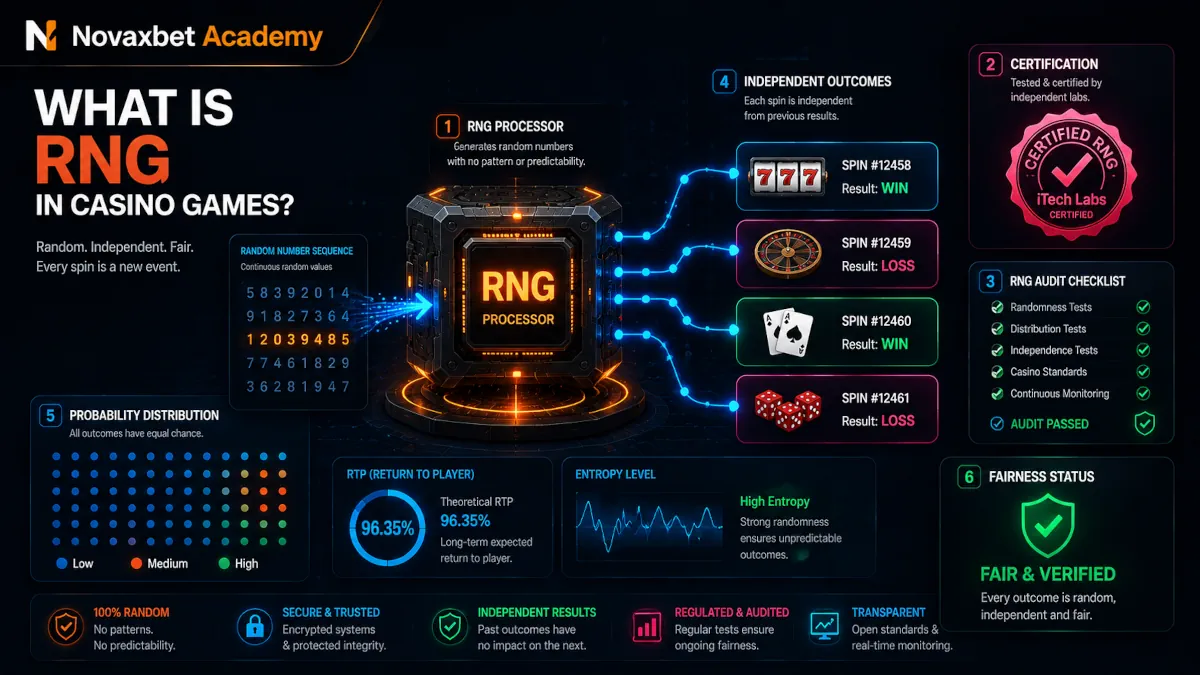
What Is RNG in Casino Games?
Explanation of random number generators and how they produce independent game outcomes.
Novaxbet Editorial •2026-05-25•6 min read
Online casino players often hear one sentence repeatedly: “The game is RNG-based.” That phrase sounds technical, but it describes the central mechanism behind most digital casino outcomes. If you understand RNG correctly, many common myths about hot machines, due wins, and manipulated streaks become easier to evaluate.
This article explains what RNG means in casino games, how RNG outcomes are used in game engines, how fairness controls are applied, and what RNG does not mean. The goal is practical understanding for players, support teams, and operational readers.
Core Definition: What RNG Means
Next reading
RNG stands for Random Number Generator. In online casino context, it is software logic that produces unpredictable values used to resolve game rounds.
In simplified form, RNG-driven resolution looks like this:
- Player submits a bet.
- System locks the round.
- RNG generates value(s).
- Game engine maps values to symbols/cards/numbers.
- Rules evaluate win, loss, push, or bonus trigger.
- Wallet settlement is posted.
RNG does not “decide who should win.” It generates input values, while the game rules define what those values mean.
Why Casino Platforms Use RNG
Digital games need a consistent and scalable outcome source. RNG provides that source without requiring a physical wheel, deck, or dealer.
Operational advantages include:
- Fast round resolution.
- Repeatable technical integration across many games.
- Audit-friendly event logging.
- Consistent behavior under high traffic.
From player perspective, the key property is independence of rounds. Each valid round is resolved from current RNG output, not from a “memory ledger” that tries to compensate previous wins or losses.
How RNG Fits Into the Full Round Lifecycle
RNG is only one layer. A compliant game round usually includes the following chain.
1) Bet Validation
Before RNG is called, platform validates:
- active account status,
- sufficient balance,
- stake within game limits,
- allowed jurisdiction/session state,
- duplicate request protection.
2) Round Creation
A unique round identifier is created. This ID links the bet transaction, outcome payload, and settlement result.
3) RNG Call and Raw Output
Game service requests one or more random values. These raw values are not yet “wins” or “losses.” They are technical inputs.
4) Outcome Mapping
The game maps raw RNG output to in-game objects:
- reel stops in slots,
- card indexes in RNG card games,
- number outcomes in digital roulette variants.
5) Rules Evaluation
The rules engine checks paytable/odds logic and calculates gross and net result.
6) Settlement and Logging
Wallet updates are posted. Round status and event data are stored for reconciliation and support diagnostics.
Independence of Outcomes: The Most Important Concept
If a game is operating normally, one resolved round does not increase or decrease the mathematical chance of a specific outcome in the next round.
This is where many misconceptions appear:
- “I lost 20 spins, so a big win is due.”
- “Three reds in roulette means black is now more likely.”
- “The game paid recently, so it will stay cold.”
These statements confuse historical sequence with forward probability. Past results are historical facts, not future guarantees.
RNG, RTP, and Volatility: Different Concepts
Players often mix these terms. They are related but not interchangeable.
| Concept | What it describes | What it does not guarantee |
|---|---|---|
| RNG | Per-round random input generation | Any fixed short-session payout |
| RTP | Long-run theoretical return ratio | Return in one session or one day |
| Volatility | Distribution pattern of wins | That losses/wins will be smooth |
A game can have stable RTP and still produce long dry streaks or sudden large wins because volatility shapes distribution. RNG drives the individual draw events inside that distribution.
Practical Example: Slot Mapping Flow
Assume a 5-reel slot where each reel has indexed symbol positions.
Simplified technical sequence:
- Player stakes €1 and presses spin.
- Game requests five RNG values.
- Each value is converted to a reel index.
- Visible symbol matrix is constructed.
- Paylines and feature rules are evaluated.
- Result is posted (for example: €0, €0.40, €7.50, or bonus entry).
Important point: animation is presentation. The result is already determined once RNG output is captured and mapped.
Testing, Certification, and Auditing (High-Level)
Regulated environments generally require technical controls around RNG games. Exact frameworks vary by jurisdiction, but common control families include:
- randomness quality testing,
- implementation consistency checks,
- payout model verification against declared math,
- operational logging and traceability,
- change-management controls on production deployments.
For support and compliance teams, the critical outcome is not “perfectly even short-term results,” but evidence that game logic follows approved rules and that round-level records are traceable.
What RNG Does Not Mean
RNG is frequently misunderstood in both directions.
Misunderstanding A: “RNG means guaranteed fairness in every short session.”
Not correct. Random systems naturally create streaks, clusters, and uneven short samples.
Misunderstanding B: “RNG means the platform can freely rig outcomes.”
Also not correct in regulated contexts. Platforms are constrained by technical architecture, provider controls, and audit expectations.
Misunderstanding C: “Near misses prove the game is about to pay.”
Near-miss visuals can feel meaningful, but they do not establish future payout certainty. The next round remains a separate random event under the game model.
Support Diagnostics: How to Explain RNG Complaints
When a player reports “impossible bad luck” or “suspicious pattern,” support teams should avoid emotional debate and focus on structured diagnostics:
- Confirm round IDs and timestamps.
- Verify stake and settlement records.
- Check if any round was voided, retried, or interrupted.
- Confirm game version/provider reference.
- Explain independence and variance in clear language.
Useful communication style:
- factual,
- non-defensive,
- specific to recorded rounds,
- free of promises about future outcomes.
Responsible Interpretation for Players
RNG literacy helps players separate mechanics from expectations.
Practical takeaways:
- Treat each round as independent.
- Use RTP and volatility as long-run guidance, not session promises.
- Avoid escalation logic based on “due” outcomes.
- Set bankroll limits before play.
- Stop sessions based on budget/time rules, not streak emotions.
These habits do not change mathematical expectation, but they reduce decision errors caused by probability misconceptions.
Conclusion
RNG is the core engine behind most online casino game outcomes. It provides random per-round inputs that game rules convert into financial results.
To evaluate RNG games correctly, keep four ideas together:
- round independence,
- rule-based mapping,
- long-run metrics (RTP/house edge),
- variance through volatility.
Once these concepts are clear, casino outcomes become easier to read operationally, and common fairness myths are easier to challenge with evidence rather than intuition.