
 Français
  Deutsch
  Español
  Italiano
  Nederlands
  Português
  Brasileiro
  Ελληνικά
  Polski
  Română
  Svenska
  Türkçe
  Български
  हिंदी
हिंदी 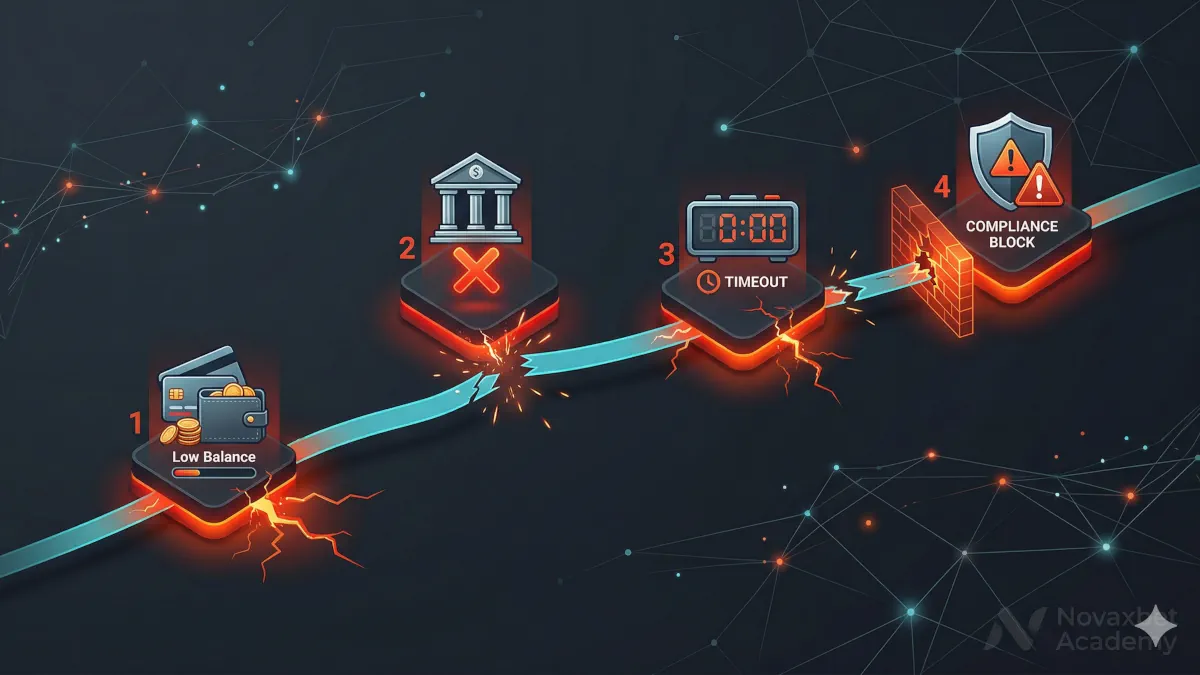
Why Bank Deposits Fail
Common reasons why bank deposits fail and how payment systems handle them.
Novaxbet Editorial •2026-05-06•4 min read
Bank deposits do not always succeed, even when using instant payment methods. Failures can happen at different stages of the payment process and are often caused by technical, banking, or compliance factors.
Understanding why deposits fail helps users resolve issues faster and avoid repeated errors.
What Is a Failed Deposit
Next reading
A failed deposit is a transaction that does not complete successfully.
This means:
- funds are not transferred
- the platform does not receive confirmation
- the user balance is not credited
Failures can occur before or after authorization.
Common Reasons Deposits Fail
There are multiple causes of failure across the payment lifecycle.
Insufficient Funds
The bank account does not have enough balance to complete the transaction.
Incorrect Authentication
The user fails to complete bank authentication correctly.
Bank Rejection
The bank declines the transaction due to internal rules.
Payment Timeout
The process takes too long and expires.
API Communication Errors
The connection between systems fails.
Each of these can interrupt the payment flow.
Failures During Authorization
Authorization failures happen before the payment is approved.
Typical causes include:
- low account balance
- failed login or authentication
- bank risk controls
In these cases, the transaction is stopped immediately.
Failures After Authorization
Even after authorization, deposits can still fail.
Possible reasons:
- processing errors in payment networks
- clearing issues
- compliance checks
The payment may be reversed or not completed.
Role of Bank Security Checks
Banks apply security rules to protect users.
These checks may block transactions if:
- unusual activity is detected
- the payment pattern looks risky
- limits are exceeded
Security systems can prevent completion even for valid users.
Compliance and Regulatory Blocks
Payments may be blocked due to regulatory requirements.
Examples include:
- AML checks
- KYC issues
- jurisdiction restrictions
These checks ensure legal compliance but can delay or stop deposits.
Technical Failures in Payment Systems
Technology issues can interrupt deposits.
Examples:
- server downtime
- API failures
- network connectivity problems
These issues are usually temporary but affect processing.
User Input Errors
Mistakes made by users can cause failures.
Common examples:
- selecting the wrong bank
- entering incorrect details
- cancelling the process early
Accurate input is critical for success.
Payment Timeouts Explained
Some payment flows require completion within a time limit.
If exceeded:
- the session expires
- the transaction is cancelled
Users must restart the process.
What Happens to the Money
When a deposit fails:
- funds are not debited
- or automatically returned
In rare cases, temporary holds may occur but are released.
Error Messages and Feedback
Systems usually provide feedback when failures occur.
Examples:
- declined by bank
- authentication failed
- timeout error
Understanding these messages helps identify the cause.
How to Retry a Failed Deposit
Users can often retry successfully.
Recommended steps:
- check account balance
- verify bank login details
- ensure stable internet connection
- follow the process without interruption
Retrying resolves many temporary issues.
Preventing Deposit Failures
Users can reduce failure risk by:
- using correct bank credentials
- completing authentication promptly
- avoiding multiple rapid attempts
- ensuring sufficient funds
Preparation improves success rates.
When to Contact Support
Support may be needed if:
- failures repeat
- funds appear deducted but not credited
- error messages are unclear
Providing transaction details speeds up resolution.
Understanding Failures Improves Payments
Instead of assuming:
“The system is broken”
A better understanding is:
“Different systems rejected or interrupted the transaction”
Recognizing failure points helps users navigate payments more effectively.