
 Français
  Deutsch
  Español
  Italiano
  Nederlands
  Português
  Brasileiro
  Ελληνικά
  Polski
  Română
  Svenska
  Türkçe
  Български
  हिंदी
हिंदी 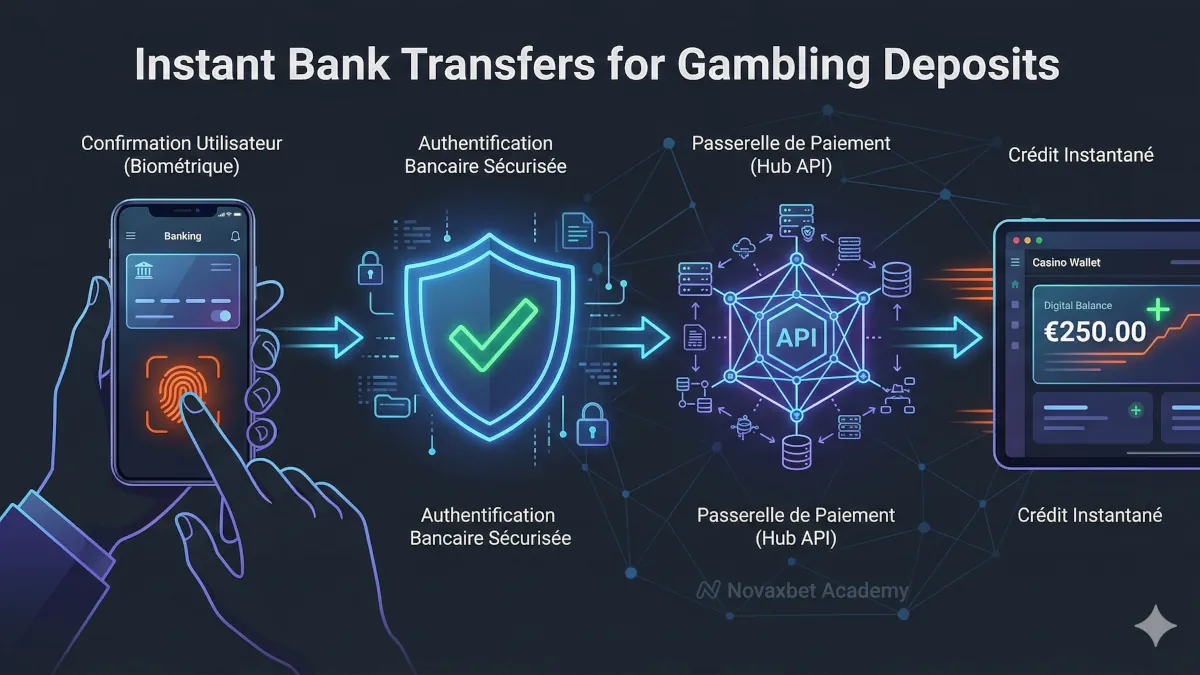
How Instant Bank Transfers Work for Gambling Deposits
Clear explanation of how instant bank transfers process deposits, including authorization, settlement, and common issues.
Novaxbet Editorial •2026-04-22•4 min read
Instant bank transfers allow users to deposit funds directly from their bank account into a platform in real time. They use modern banking infrastructure to move money quickly without manual input.
These systems are widely used for gambling deposits due to their speed and reliability.
Understanding how they work helps users interpret payment confirmations, delays, and failures.
What Is an Instant Bank Transfer
An instant bank transfer is a payment method that moves funds directly between bank accounts within seconds.
It typically uses:
- open banking infrastructure
- real-time payment rails
- bank authentication systems
Unlike traditional transfers, it does not require manual entry of bank details.
Key Components of the Payment Flow
Instant bank transfers involve several components working together.
User Interface
The player selects their bank and initiates the payment.
Payment Service Provider
The provider connects the platform to banking systems.
Bank API
The bank processes authentication and payment authorization.
Payment Rails
The network transfers funds between banks.
Each component plays a role in completing the transaction.
Step-by-Step Deposit Flow
The process follows a structured sequence.
Payment Initiation
The user selects instant bank transfer as a deposit method.
Bank Selection
The user chooses their bank from a list.
Authentication
The user logs into their bank and confirms the payment.
Authorization
The bank approves the transaction.
Execution
Funds are sent through payment rails.
Confirmation
The platform receives confirmation and credits the deposit.
This entire process can occur within seconds.
Role of Open Banking
Open banking enables secure communication between platforms and banks.
It allows:
- direct payment initiation
- real-time account verification
- secure authentication
Users do not share sensitive details with the platform.
Authorization vs Settlement
Two key stages exist in payments:
Authorization
The bank confirms that funds are available and approves the transaction.
Settlement
The actual transfer of funds between banks is completed.
In instant payments, these steps often happen almost simultaneously.
Real-Time Payment Networks
Instant transfers rely on real-time networks.
Examples include:
- SEPA Instant
- Faster Payments
- other regional instant systems
These networks process payments continuously, including weekends.
Security and Authentication
Security is handled at the bank level.
Users typically confirm payments using:
- biometric authentication
- banking apps
- secure login credentials
This reduces fraud risk compared to manual entry methods.
Payment Confirmation and Crediting
Once the bank authorizes the transaction:
- the payment provider receives confirmation
- the platform credits the user account
This happens before or alongside settlement in most systems.
Common Processing Issues
Despite speed, issues can occur.
Examples include:
- bank downtime
- API communication errors
- authentication failures
- user cancellation
These issues can interrupt the payment flow.
Handling Failed Transactions
If a transaction fails:
- no funds are transferred
- or funds are automatically returned
The system may display error messages.
Users can retry once the issue is resolved.
Role of Payment Providers
Payment service providers act as intermediaries.
They:
- connect platforms to banks
- manage API integrations
- handle transaction routing
They do not hold user funds directly.
Compliance and Checks
Payments may be subject to:
- identity verification
- fraud checks
- AML monitoring
These checks can affect approval speed.
Why Instant Transfers Are Preferred
Instant bank transfers offer advantages:
- speed
- reduced manual input
- high security
- direct bank interaction
They simplify the deposit experience.
Understanding the Full Payment Lifecycle
An instant bank transfer involves multiple steps:
- initiation
- authentication
- authorization
- execution
- settlement
Each step contributes to a successful transaction.
Transparency in Payment Processing
Users often see only the confirmation step.
However, multiple systems operate in the background.
Instead of asking:
“Why was my deposit instant?”
A better question is:
“How did each step complete successfully?”
Understanding this improves payment awareness.