
 Français
  Deutsch
  Español
  Italiano
  Nederlands
  Português
  Brasileiro
  Ελληνικά
  Polski
  Română
  Svenska
  Türkçe
  Български
  हिंदी
हिंदी 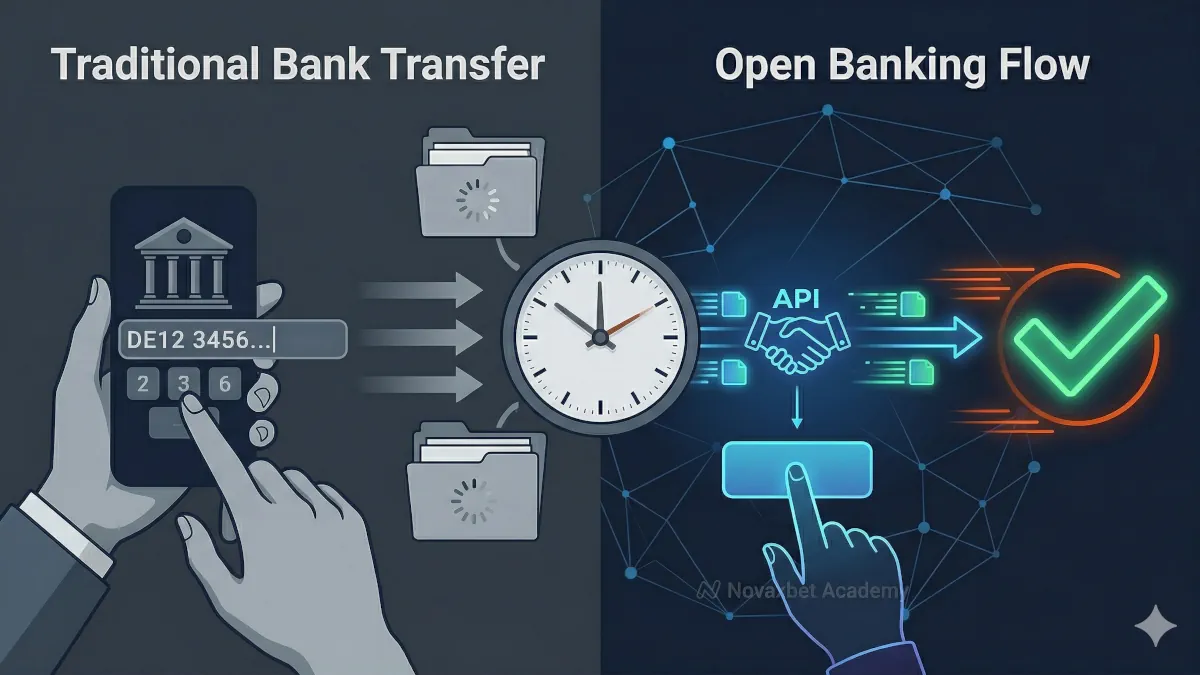
Open Banking vs Traditional Bank Transfers
Comparison between open banking payments and traditional bank transfer methods.
Novaxbet Editorial •2026-04-22•3 min read
Open banking payments and traditional bank transfers are both methods of moving money between bank accounts. However, they differ significantly in speed, user experience, and technical structure.
Understanding these differences helps users choose the most efficient payment method.
What Is Open Banking Payment
Next reading
Open banking payments allow users to initiate transfers directly from their bank through a secure API connection.
The process is integrated into the platform.
Users:
- select their bank
- authenticate securely
- confirm payment instantly
The system connects directly to the bank without manual steps.
What Is a Traditional Bank Transfer
A traditional bank transfer requires users to manually send money using their banking interface.
The process typically involves:
- copying account details
- entering payment references
- confirming the transfer manually
This method relies on user input and external banking systems.
Speed Comparison
Speed is one of the biggest differences.
Open Banking
- near-instant processing
- real-time confirmation
Traditional Transfer
- minutes to days
- dependent on bank processing times
Instant systems provide faster user feedback.
User Experience
User flow differs significantly.
Open Banking
- seamless integration
- guided process
- minimal manual input
Traditional Transfer
- manual steps
- risk of input errors
- fragmented experience
Open banking simplifies the process.
Payment Confirmation
Confirmation timing varies.
Open Banking
- immediate confirmation
- automatic account crediting
Traditional Transfer
- delayed confirmation
- manual reconciliation sometimes required
This affects how quickly deposits are usable.
Security Model
Both methods are secure but operate differently.
Open Banking
- bank-level authentication
- no sharing of credentials with platforms
- encrypted API communication
Traditional Transfer
- manual data entry
- risk of incorrect details
- reliance on user accuracy
Open banking reduces user error risk.
Technical Infrastructure
The underlying systems differ.
Open Banking
- API-driven communication
- direct bank integration
- real-time payment rails
Traditional Transfer
- batch processing systems
- indirect routing
- manual initiation
Infrastructure impacts speed and reliability.
Error Handling
Errors occur differently in each system.
Open Banking
- instant failure feedback
- retry options
Traditional Transfer
- delayed detection of errors
- potential misdirected funds
Real-time systems provide faster issue visibility.
Use Cases
Each method fits different scenarios.
Open Banking
- instant deposits
- real-time payments
- integrated platforms
Traditional Transfer
- scheduled payments
- large transfers
- offline banking workflows
Choice depends on user needs.
Reliability and Availability
Both systems are reliable but behave differently.
Open Banking
- depends on API uptime
- requires bank connectivity
Traditional Transfer
- works even without platform integration
- may operate during limited hours
Availability varies by system design.
Why Platforms Prefer Open Banking
Platforms often prioritize open banking because:
- faster deposits
- improved user experience
- reduced operational friction
It enables smoother transaction flows.
Comparing Payment Methods Clearly
Instead of asking:
“Which method is better?”
A more useful question is:
“Which method fits my use case?”
Open banking focuses on speed and automation.
Traditional transfers focus on flexibility and manual control.
Understanding both allows better payment decisions.