
 Français
  Deutsch
  Español
  Italiano
  Nederlands
  Português
  Brasileiro
  Ελληνικά
  Polski
  Română
  Svenska
  Türkçe
  Български
  हिंदी
हिंदी 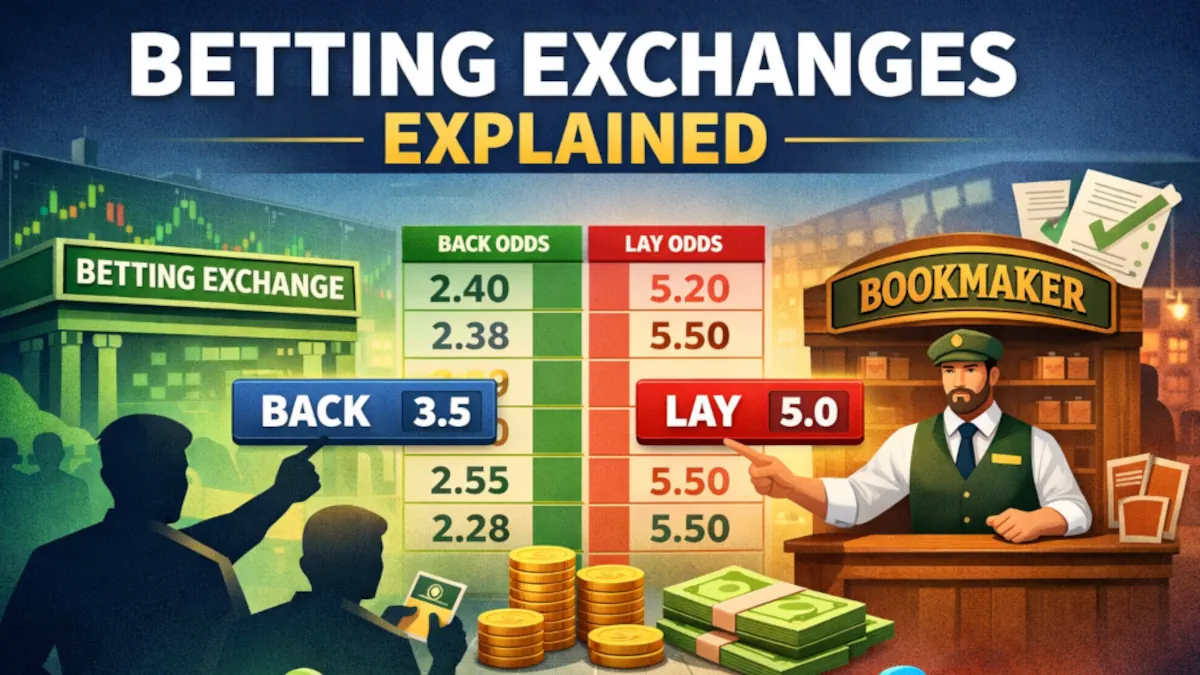
What Is a Betting Exchange and How Does It Work?
A complete explanation of betting exchanges and how they differ from traditional sportsbooks.
Novaxbet Editorial •2026-02-12•6 min read
Introduction
This article explains what a betting exchange is, how it works, and how it differs from a traditional sportsbook.
It is written primarily for players who want to understand the structural mechanics behind exchange betting, but it is also relevant for agents and affiliates.
Clear Definition
A betting exchange is a peer-to-peer betting platform where users bet against each other instead of against a bookmaker.
In short, the platform does not set odds or take risk. It matches users who want to back an outcome with users who want to lay that same outcome. The exchange earns revenue by charging a commission on net winnings.
How a Betting Exchange Works
Step 1 — Back and Lay Positions
On a betting exchange, every market has two sides:
- Back bet: You bet that something will happen.
- Lay bet: You bet that something will not happen.
If one user backs a team to win, another user must lay that same outcome for the bet to be matched.
Step 2 — The Order Book
A betting exchange operates similarly to a financial order book.
Users place offers at specific odds.
For example:
- User A backs Team A at odds 2.50 with a stake of €100.
- User B lays Team A at odds 2.50 with a stake of €100.
When both sides match, the bet becomes active.
If no matching offer exists, the bet remains unmatched until:
- Another user accepts it.
- The user cancels it.
- The market closes.
Step 3 — Liability and Profit Calculation
Back Bet Example
- Stake: €100
- Odds: 2.50
If the outcome wins:
Profit = (Odds − 1) × Stake
Profit = (2.50 − 1) × 100 = €150
Total return = €250
If the outcome loses:
Loss = €100
Lay Bet Example
- Stake (backer’s stake): €100
- Odds: 2.50
As the layer, your potential loss is called liability.
Liability = (Odds − 1) × Stake
Liability = (2.50 − 1) × 100 = €150
If the outcome loses:
You win €100
If the outcome wins:
You lose €150
Step 4 — Commission
Unlike a bookmaker, an exchange does not build a margin into the odds.
Instead, it charges a commission on net winnings.
Example:
- Net winnings: €150
- Commission: 5%
Commission paid = €7.50
Net profit after commission = €142.50
No commission is charged on losing bets.
Key Concepts Explained
Peer-to-Peer Betting
Users bet against each other.
The platform acts only as an intermediary.
Liquidity
Liquidity refers to the amount of money available to match bets at different odds levels.
High liquidity:
- Faster matching
- Smaller price gaps
- More stable markets
Low liquidity:
- Unmatched bets
- Larger spreads
- Higher volatility
Order Matching
Bets are matched based on:
- Best available odds
- Time priority
Earlier unmatched offers at the same price are matched first.
Price Movement
Odds move when:
- New money enters the market
- Users adjust positions
- External information changes expectations
Unlike sportsbooks, exchange odds are shaped directly by user activity.
How a Betting Exchange Differs from a Bookmaker
Risk Model
Bookmaker:
- Sets odds
- Takes direct risk
- Builds margin into pricing
Exchange:
- Matches users
- Takes no directional risk
- Charges commission
Pricing Structure
Bookmakers embed margin within odds.
Exchanges provide market-driven pricing, typically closer to true probability when liquidity is high.
Market Flexibility
On an exchange, users can:
- Back
- Lay
- Trade positions
- Close exposure before event completion
This creates more strategic flexibility than fixed-odds betting.
Practical Example: Full Market Scenario
Suppose a football match has the following exchange prices:
Team A:
- Back: 2.48
- Lay: 2.50
The small difference (spread) reflects supply and demand.
If large money enters on Team A, odds may move to:
- Back: 2.30
- Lay: 2.32
Users who backed earlier at 2.48 may now choose to lay at 2.30 to lock in profit.
This mechanism enables trading behavior within betting markets.
Who a Betting Exchange Is For
Players
- Those who want pricing transparency
- Those who want to lay outcomes
- Those who want trading flexibility
Agents
- Those managing player liquidity
- Those analyzing margin differences
- Those interested in structural pricing advantages
Affiliates
- Those targeting advanced bettors
- Those explaining exchange mechanics
- Those building educational funnels
Common Misunderstandings
“An exchange guarantees better odds.”
Not always.
Better pricing depends on liquidity and market depth.
“Lay betting is risk-free.”
Lay betting exposes the user to liability.
Risk can exceed the original stake.
“Exchanges eliminate risk.”
All betting involves risk.
The exchange model changes who holds the risk, not whether risk exists.
FAQ
1. Is a betting exchange legal?
It depends on jurisdiction. Exchanges operate under regulatory frameworks in certain markets.
2. Do exchanges manipulate odds?
No. Prices move based on user supply and demand.
3. Can you lose more than your stake?
Yes, when placing lay bets. Liability can exceed the backer’s stake.
4. Why are exchange odds sometimes higher?
Because no built-in bookmaker margin exists; instead, commission is charged on winnings.
5. What happens if a bet is not matched?
It remains unmatched and does not become active.
6. Does an exchange profit if I lose?
No. It earns commission only on net winnings.
7. Is liquidity the same in every sport?
No. Major sports typically have higher liquidity.
8. Can beginners use a betting exchange?
Yes, but understanding liability and order matching is essential.
Short Summary
A betting exchange is a peer-to-peer betting platform where users back and lay outcomes against each other.
The platform matches bets, charges commission on winnings, and does not take direct market risk.
Understanding liquidity, liability, and order matching is essential for using an exchange effectively.