
 Français
  Deutsch
  Español
  Italiano
  Nederlands
  Português
  Brasileiro
  Ελληνικά
  Polski
  Română
  Svenska
  Türkçe
  Български
  हिंदी
हिंदी 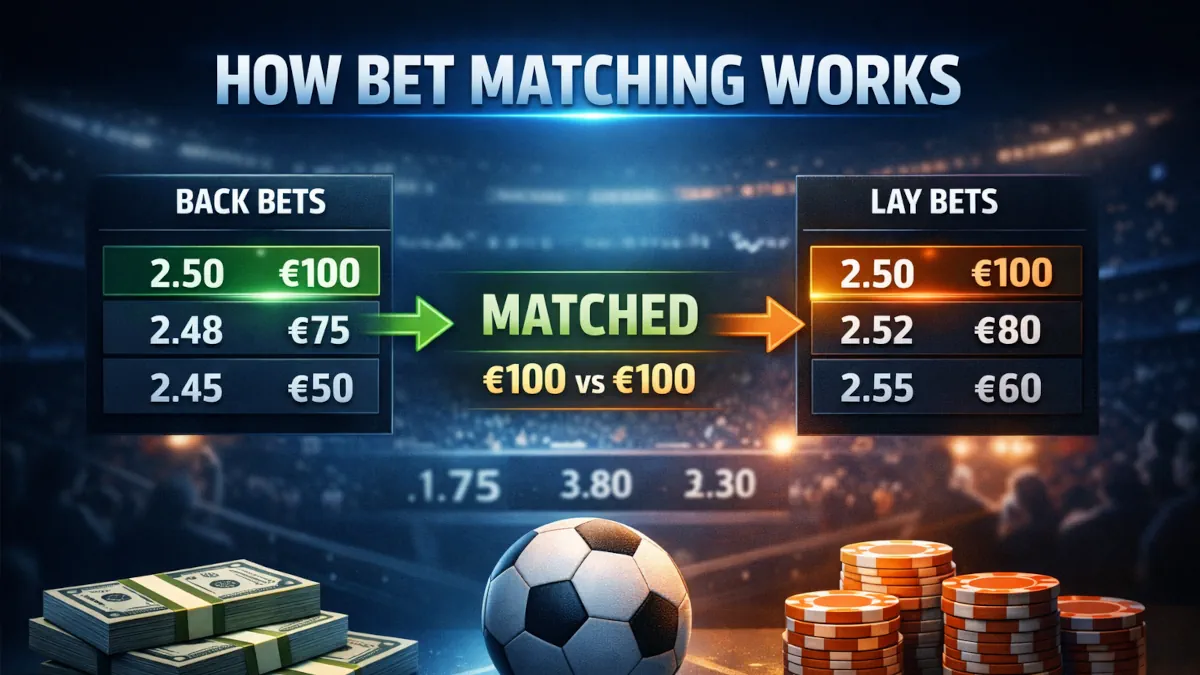
How Bet Matching Works on a Betting Exchange
Explanation of price-time priority, partial matches, and unmatched bets in exchange markets.
Novaxbet Editorial •2026-02-26•4 min read
Introduction
Next reading
This article explains how bet matching works on a betting exchange. It focuses on the mechanics of the *matching engine, the principle of **price-time priority, and how *partial matching occurs when liquidity is limited.
It builds on the previous articles about liquidity and the order book, completing the structural understanding of how exchange markets execute bets.
Definition
Bet matching is the process by which a betting exchange pairs opposing back and lay bets at compatible prices.
Unlike a bookmaker, the exchange does not take the opposite side of your bet.
Instead, it matches your bet with another user.
Matching occurs when:
- A back bet meets a lay bet
- Both agree on the same price
- Sufficient liquidity is available
The Matching Engine
The matching engine is the automated system that processes and pairs bets.
Its role is to:
- Scan the order book
- Identify compatible prices
- Execute matches instantly
- Apply price-time priority rules
The matching engine ensures fairness and efficiency in execution.
Price-Time Priority Explained
Betting exchanges use price-time priority to determine the order in which bets are matched.
1. Price Priority
Better prices are matched first.
For example:
If a layer offers:
- 2.00
- 2.02
A back bet at 2.00 will match before 2.02.
The market always prioritizes the most competitive price.
2. Time Priority
If multiple bets exist at the same price:
- The bet placed earlier is matched first
- Later bets must wait
Example:
Two lay bets at 2.02:
- Bet A placed at 12:01
- Bet B placed at 12:03
Bet A is matched first.
This rule guarantees predictable execution.
Full Matching
A bet is fully matched when:
- Opposing liquidity equals or exceeds your stake
- The entire amount is paired immediately
Example:
You back €1,000 at 2.00.
€3,000 is available at 2.00.
Result:
- €1,000 fully matched
- No unmatched remainder
Partial Matching
Partial matching occurs when:
- Available liquidity is less than your requested stake
Example:
You back €5,000 at 2.00.
Only €2,000 is available at 2.00.
Result:
- €2,000 matched
- €3,000 remains unmatched
The unmatched portion stays in the order book until:
- It is matched
- It is cancelled
- The market closes
Matching Across Multiple Price Levels
If you allow price movement, your bet may match across multiple levels.
Example:
You back €5,000 at 2.02 or better.
Available liquidity:
- 2.00 — €2,000
- 2.02 — €3,000
Result:
- €2,000 matched at 2.00
- €3,000 matched at 2.02
This is known as price improvement or multi-level matching.
Unmatched Bets
A bet remains unmatched when:
- No opposing liquidity exists at your chosen price
- Your price is less competitive than current best offers
Unmatched bets:
- Appear in the order book
- Can be edited or cancelled
- May match later if market conditions change
In-Play Matching
During live events:
- Matching may be briefly delayed
- Price changes occur rapidly
- Liquidity may fluctuate
Exchanges often apply in-play delay to maintain market integrity.
Why Matching Mechanics Matter
Understanding bet matching helps with:
- Avoiding unexpected partial fills
- Improving entry timing
- Reducing slippage
- Executing trading strategies
- Managing execution risk
Professional traders consider matching probability before placing large bets.
Common Mistakes and Misunderstandings
1. Assuming Immediate Execution Is Guaranteed
Execution depends on available liquidity.
2. Ignoring Time Priority
Placing a bet later at the same price may delay matching.
3. Confusing Unmatched Bets With Lost Bets
Unmatched bets carry no risk until matched.
4. Forgetting Market Closure Rules
Unmatched bets are cancelled when a market suspends or settles.
FAQ
1. Does the exchange take the opposite side of my bet?
No. Another user matches your bet.
2. Can my bet be partially matched?
Yes, if liquidity is insufficient.
3. What happens to unmatched bets?
They remain in the order book until matched, cancelled, or market closure.
4. Can I cancel an unmatched bet?
Yes, at any time before market suspension.
5. Why was my bet matched at a better price?
Because better prices were available in the order book.
6. Does commission affect matching?
No. Commission applies only after settlement.
7. Is matching instant?
Usually yes, but delays may apply during in-play betting.
Summary
Bet matching is the core execution process of a betting exchange.
- Matches opposing back and lay bets
- Follows price-time priority
- Allows partial matching
- Depends on available liquidity
Understanding how matching works is essential for accurate execution, risk control, and advanced exchange trading.