
 Français
  Deutsch
  Español
  Italiano
  Nederlands
  Português
  Brasileiro
  Ελληνικά
  Polski
  Română
  Svenska
  Türkçe
  Български
  हिंदी
हिंदी 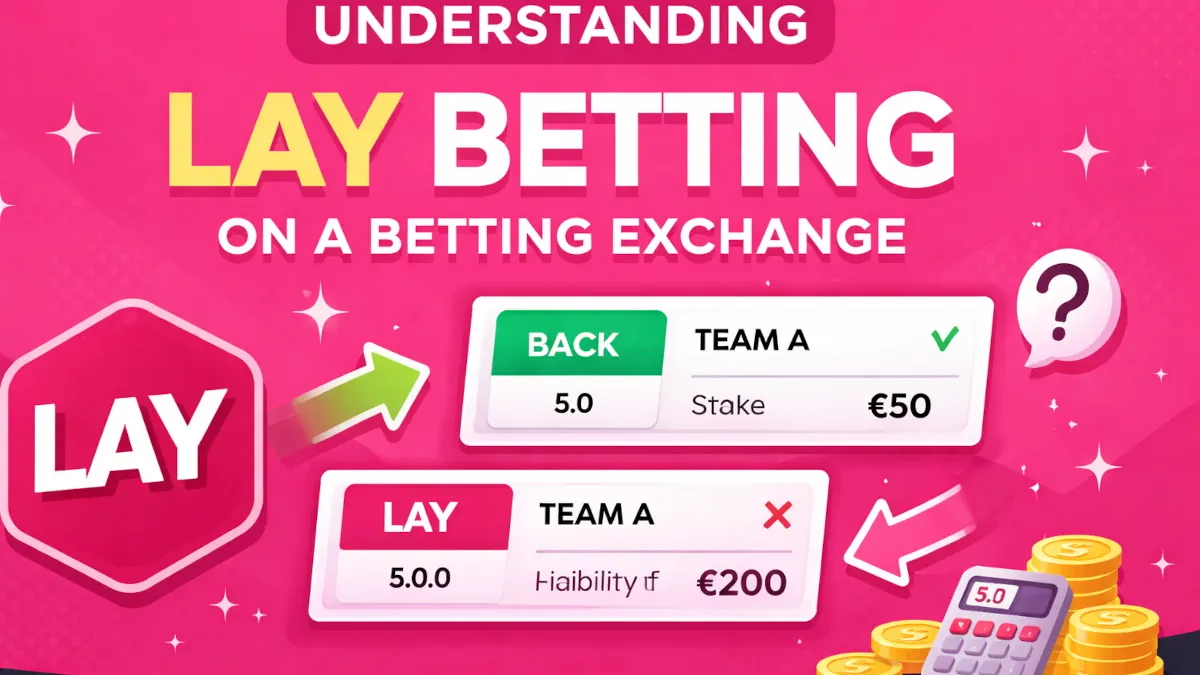
What Is a Lay Bet?
Understanding lay betting and liability on an exchange.
Novaxbet Editorial •2026-02-12•5 min read
Part of: Betting Exchange cluster
Who this is for: Players who want to understand how laying works on a betting exchange
Reading level: Intermediate
Intro
Next reading
This article explains what a lay bet is and how it works on a betting exchange.
It is designed for players who already understand basic exchange concepts and want to understand liability and risk exposure more clearly.
If you are new to exchanges, read the pillar article on what a betting exchange is first.
In short
A lay bet is a bet placed against an outcome on a betting exchange.
When you lay a selection, you are offering odds to another user who wants to back it. If the selection loses, you win their stake. If the selection wins, you must pay out at the agreed odds. The maximum amount you can lose is called your liability.
What a lay bet means
On a traditional sportsbook, you can only back outcomes.
On a betting exchange, you can:
- Back an outcome (bet it will happen)
- Lay an outcome (bet it will not happen)
When you place a lay bet:
- You act similarly to a bookmaker.
- You accept someone else’s back bet.
- You take on financial risk if the outcome occurs.
The exchange itself does not take the risk. It only matches users and charges commission on net winnings.
How a lay bet works (step-by-step)
- You select an outcome in the market (for example, Team A to win).
- Instead of backing it, you choose the lay option.
- You enter the odds you are willing to offer.
- Another user backs that selection at your odds.
- The exchange matches the bets.
- After settlement:
- If the outcome does not happen → you win the backer’s stake.
- If the outcome happens → you pay out your liability.
Stake vs Liability (critical difference)
Understanding the difference between stake and liability is essential.
- Stake (backer’s stake): The amount the other user risks.
- Liability (your risk as layer): The maximum amount you can lose.
Liability formula
Liability = (Odds − 1) × Stake
This means higher odds create higher liability.
Example with numbers
Suppose:
- You lay Team A at odds of 3.00
- The backer stakes €50
Your liability is:
(3.00 − 1) × 50
= 2.00 × 50
= €100
Two possible outcomes:
If Team A loses:
You win the backer’s €50 (minus commission on net winnings).
If Team A wins:
You lose €100.
This shows that your risk is not the stake amount — it is the liability.
Why players use lay bets
Lay bets are commonly used for:
- Taking a position against an overvalued outcome
- Hedging an existing back bet
- Managing exposure during live markets
- Trading price movements before an event ends
Lay betting allows more flexibility compared to traditional sportsbooks because it enables two-sided market participation.
Key concepts explained
- Lay bet: A bet that an outcome will not happen.
- Liability: The maximum loss on a lay bet.
- Back bet: A bet that an outcome will happen.
- Betting exchange: A peer-to-peer marketplace where users bet against each other.
- Commission: A fee charged on net winnings by the exchange.
Common mistakes
- Confusing stake with liability
- Underestimating risk at high odds
- Ignoring liquidity before placing large lay bets
- Forgetting that commission applies to net winnings
FAQ
Is laying the same as betting against a team?
Yes. A lay bet means you are betting that the selected outcome will not happen.
Can I lose more than my account balance?
No. Exchanges require sufficient funds to cover your liability before the bet is matched.
Why is liability higher at bigger odds?
Because liability increases in proportion to (odds − 1). Higher odds multiply risk.
Do exchanges profit if I lose a lay bet?
No. The exchange charges commission only on net winnings, not on losses.
Can I cancel a lay bet?
You can cancel it if it is unmatched. Once matched, it cannot be cancelled.
Is laying riskier than backing?
It depends on the odds and position. Lay bets often involve larger liability than the backer’s stake.
Summary
A lay bet is a core mechanism of a betting exchange. It allows users to bet against outcomes and take on liability in exchange for potentially winning another user’s stake.
Understanding liability, odds, and exposure is essential before placing lay bets. Lay betting provides flexibility, but it requires careful risk awareness.
Next reading
- What Is a Betting Exchange?
- What Is Liquidity on a Betting Exchange?
- How Commission Works on a Betting Exchange
- How Bets Are Matched on a Betting Exchange