
 Français
  Deutsch
  Español
  Italiano
  Nederlands
  Português
  Brasileiro
  Ελληνικά
  Polski
  Română
  Svenska
  Türkçe
  Български
  हिंदी
हिंदी 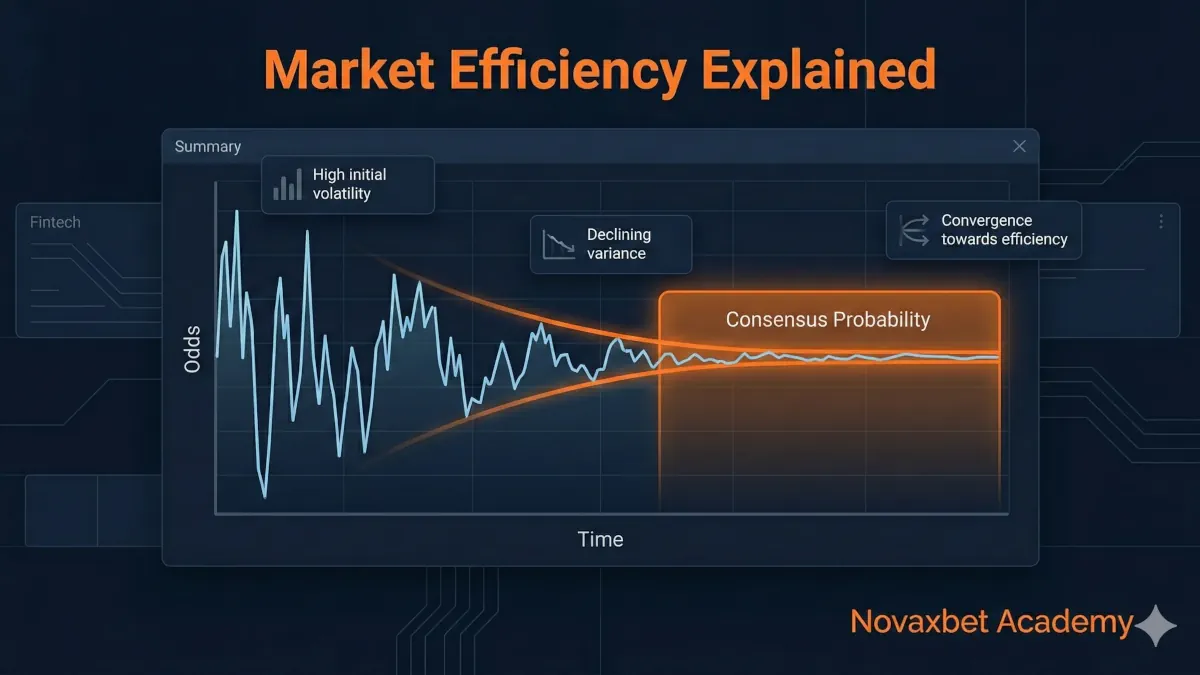
Market Efficiency Explained in Betting Exchanges
How information and liquidity affect pricing accuracy on exchanges.
Novaxbet Editorial •2026-03-07•5 min read
In betting exchanges, prices are often assumed to represent accurate probabilities. However, accuracy is not imposed by design — it emerges through interaction.
Market efficiency describes how quickly and accurately available information becomes reflected in exchange prices.
An efficient market is not one where prices are always correct, but one where mispricing cannot persist for long once information becomes available.
Exchange markets continuously evolve toward consensus through competition between participants with differing opinions, capital sizes, and reaction speeds.
Price Discovery as a Continuous Process
Next reading
Unlike fixed-odds environments, betting exchanges operate through ongoing price discovery.
Every matched trade contributes information:
- a back bet signals perceived undervaluation,
- a lay bet signals perceived overvaluation,
- unmatched orders reveal expectations about future price direction.
Prices adjust not because certainty exists, but because disagreement is resolved through capital commitment.
Market price becomes the temporary equilibrium between opposing beliefs.
Efficiency is therefore dynamic, not static.
Information Incorporation
Information enters exchange markets from multiple sources simultaneously:
- statistical analysis,
- public news,
- insider interpretation,
- live match developments,
- liquidity provider positioning.
Participants interpret identical information differently.
Efficiency emerges when competitive trading forces prices to incorporate the aggregate interpretation faster than individuals can exploit it.
Example:
A key player injury becomes public.
Early participants adjust positions immediately. Liquidity shifts. Odds drift rapidly.
Within minutes, the informational advantage disappears as the new probability becomes embedded in price.
Strong vs Weak Efficiency in Exchanges
Market efficiency can be understood across different informational layers.
Weak Efficiency
Prices reflect historical price movement and publicly visible market behavior.
Past odds alone cannot reliably predict future movement.
Semi-Strong Efficiency
Prices rapidly integrate all publicly available information such as team news or statistics.
Opportunities exist only briefly after information release.
Strong Efficiency
Prices reflect all information, including private insights.
In practice, betting exchanges rarely achieve full strong efficiency due to unequal reaction speeds and capital access.
Exchange markets typically fluctuate between weak and semi-strong efficiency depending on liquidity and event timing.
Liquidity as the Engine of Efficiency
Efficiency depends heavily on liquidity concentration.
High liquidity markets:
- attract professional participants,
- reduce spreads,
- allow rapid correction of pricing errors.
Low liquidity markets:
- react slowly,
- permit temporary inefficiencies,
- amplify individual influence.
Example:
A Champions League match may correct mispricing within seconds.
A lower-division match opened days earlier may remain inefficient for hours.
Liquidity accelerates consensus formation.
Order Flow and Informational Signals
Not all trades carry equal informational value.
Professional participants often distinguish between:
Informational Orders
Trades motivated by analysis or new information.
These orders tend to move price permanently.
Liquidity Orders
Trades placed for hedging or position management.
These may move price temporarily without changing true probability.
Understanding whether movement reflects information or liquidity withdrawal is central to interpreting efficiency.
Arbitrage and Cross-Market Alignment
Efficiency strengthens when multiple markets interact.
Participants compare exchange prices with:
- other exchanges,
- bookmaker odds,
- derivative markets.
When discrepancies appear, arbitrage traders exploit differences.
Their activity forces rapid price convergence across platforms.
Arbitrage acts as a stabilizing mechanism.
Mispricing becomes self-correcting.
Time and Efficiency Convergence
Exchange markets generally become more efficient as event start approaches.
Three structural stages commonly appear:
Early Market Phase
- Limited participation
- Wide spreads
- High disagreement
Development Phase
- Increasing liquidity
- Active opinion competition
- Frequent adjustments
Pre-Event Phase
- Maximum participation
- Narrow spreads
- Stable consensus pricing
Efficiency increases not because uncertainty disappears, but because disagreement becomes fully priced.
Behavioral Frictions and Persistent Inefficiencies
Despite competitive forces, inefficiencies never vanish entirely.
Common structural distortions include:
- emotional betting,
- favorite–longshot bias,
- delayed reaction to complex information,
- capital constraints,
- execution latency.
Human behavior introduces noise that temporarily separates price from probability.
Efficiency is therefore probabilistic rather than absolute.
Volatility and Temporary Inefficiency
Rapid market movement often creates short-lived inefficiency.
During major events:
- liquidity relocates,
- spreads widen,
- execution delays increase.
Prices may overshoot before stabilizing.
These moments represent adjustment phases rather than permanent mispricing.
Volatility often precedes efficiency restoration.
Efficiency vs Predictability
Efficient markets are frequently misunderstood as unpredictable markets.
Efficiency does not eliminate price movement.
Instead, it ensures that predictable excess profit becomes difficult without superior information or execution capability.
Consistent advantage shifts from prediction toward:
- faster interpretation,
- better execution,
- improved risk control.
Skill migrates from outcome forecasting to market interaction.
The Limits of Market Efficiency
No exchange market reaches perfect efficiency.
Structural limits include:
- unequal technology access,
- latency differences,
- fragmented liquidity,
- participant psychology,
- information timing asymmetry.
Markets continuously approach efficiency but remain imperfect systems.
This imperfection sustains participation.
If efficiency were absolute, trading opportunity would disappear.
Understanding Efficiency in Exchange Context
Market efficiency in betting exchanges represents the collective processing power of participants competing to price uncertainty.
Odds are not forecasts produced by authority.
They are negotiated estimates refined through interaction.
Efficiency is the mechanism through which disagreement transforms into consensus probability.
Understanding efficiency allows participants to interpret price movement not as randomness, but as information transmission within a competitive system.
In exchange markets, price accuracy is not given.
It is continuously earned.