
 Français
  Deutsch
  Español
  Italiano
  Nederlands
  Português
  Brasileiro
  Ελληνικά
  Polski
  Română
  Svenska
  Türkçe
  Български
  हिंदी
हिंदी 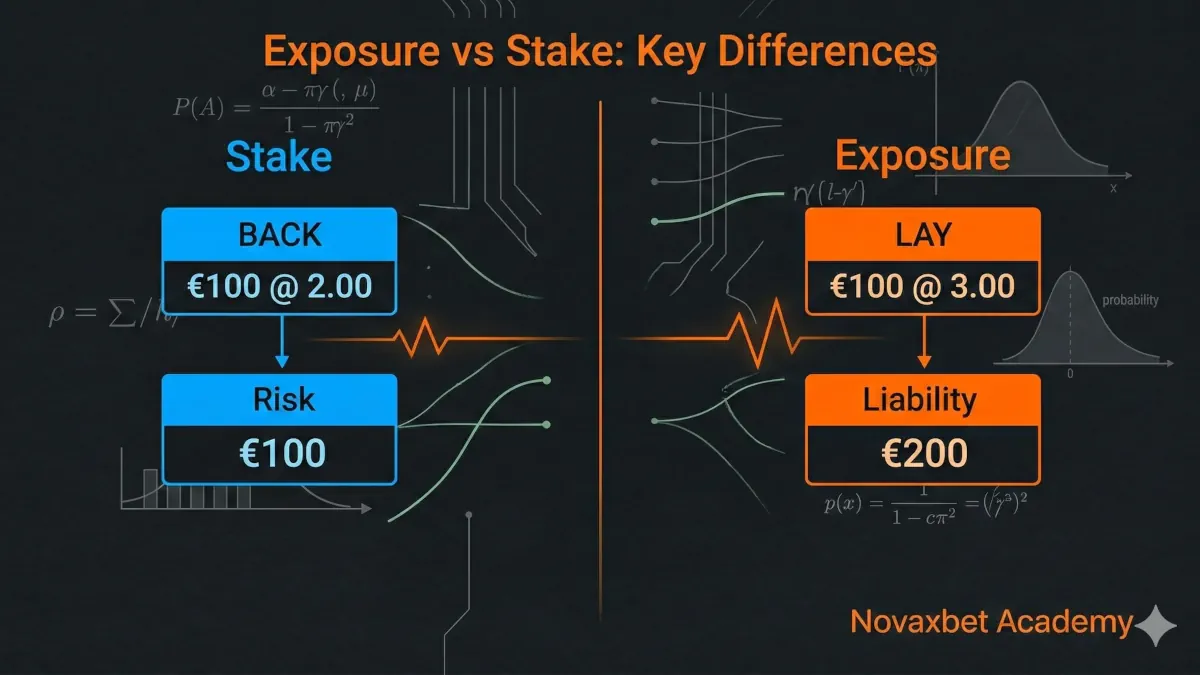
Exposure vs Stake: Key Differences
Clear comparison between stake amount and total financial exposure on exchanges.
Novaxbet Editorial •2026-03-07•5 min read
When people first interact with a betting exchange, the terms stake and exposure are often used interchangeably.
Although they are related, they represent very different aspects of risk.
The stake is the amount a participant chooses to place on a position.
Exposure, on the other hand, represents the total financial risk created by that position.
Understanding the difference between these two concepts is essential when interpreting exchange positions, particularly when laying outcomes or managing multiple bets simultaneously.
A stake describes what you invest.
Exposure describes what you could lose.
The Concept of Stake
Next reading
In the simplest sense, the stake is the amount of money placed on a bet.
It represents the initial capital committed to a position.
For a standard back bet, the stake is straightforward:
- If the bet wins → profit is calculated from the stake and odds.
- If the bet loses → the stake is lost.
Example
Back bet:
- Stake: €100
- Odds: 2.00
Possible outcomes:
| Outcome | Result |
|---|---|
| Win | Profit €100 |
| Lose | Loss €100 |
In this case, the stake and the maximum loss are the same.
This similarity often leads beginners to assume that stake and exposure are identical.
However, that relationship changes once laying or multiple positions are involved.
The Concept of Exposure
Exposure measures the maximum financial risk associated with a position.
On betting exchanges, exposure can be different from the stake because certain types of bets require accepting liability larger than the amount placed.
Exposure answers a different question than stake:
Stake asks:
How much money am I placing?
Exposure asks:
How much money could I lose if the outcome goes against me?
Exposure in Back Betting
For back bets, exposure is simple.
The maximum possible loss equals the stake.
Example:
Back bet:
- Stake: €50
- Odds: 3.00
Possible outcomes:
| Outcome | Result |
|---|---|
| Win | Profit €100 |
| Lose | Loss €50 |
Exposure = €50
Because the bettor cannot lose more than the stake, exposure and stake are equal.
Exposure in Lay Betting
Lay betting introduces the clearest difference between stake and exposure.
When laying a selection, the participant is effectively acting as the bookmaker, accepting the risk that the outcome might occur.
The stake in a lay bet represents the amount you can win, not the amount you risk.
The risk is called liability, which becomes the exposure.
Example
Lay bet:
- Lay odds: 3.00
- Stake: €100
Possible outcomes:
| Outcome | Result |
|---|---|
| Selection loses | Profit €100 |
| Selection wins | Loss €200 |
Exposure = €200
Even though the stake is €100, the exposure is twice as large because the layer must pay the backer's winnings.
Why Exchanges Emphasize Exposure
Betting exchanges track exposure rather than stake because exposure reflects the true risk to the account balance.
If exchanges only monitored stake size, participants could unintentionally create liabilities far larger than their available funds.
By calculating exposure automatically, exchanges ensure that users cannot place bets exceeding their financial capacity.
Before a bet is accepted, the exchange verifies that sufficient funds exist to cover the maximum potential loss.
Exposure Across Multiple Positions
Exposure becomes more complex when several bets interact in the same market.
Example:
A participant places two bets:
- Back Team A €100 at 2.00
- Lay Team A €100 at 1.80
Although two stakes exist, the combined exposure depends on how the outcomes offset each other.
Possible results:
| Outcome | Net Result |
|---|---|
| Team A wins | Profit €20 |
| Team A loses | Loss €0 |
The exposure is reduced because positions partially hedge each other.
In advanced exchange strategies, managing exposure across positions becomes more important than the individual stake amounts.
Exposure and Capital Allocation
Professional exchange participants think in terms of exposure allocation, not stake size.
Instead of asking:
“How large should my bet be?”
They ask:
“How much total risk should this position represent within my portfolio?”
Example:
A trader with €5,000 capital may limit exposure to:
- 2% per position
- €100 maximum exposure
This approach ensures that no single position can significantly damage the overall balance.
Exposure therefore becomes a risk management tool, not just a calculation.
Misunderstanding Stake vs Exposure
One of the most common beginner mistakes occurs when new users start laying selections without understanding liability.
Example:
Lay odds: 5.00
Stake: €100
Potential loss:
Loss = (Odds − 1) × Stake
Loss = (5.00 − 1) × 100 = €400
The stake appears modest, but the exposure becomes significantly larger.
Without understanding exposure, participants can underestimate the real risk of a position.
Exposure as the True Risk Metric
On betting exchanges, exposure represents the true measurement of financial commitment.
Stake is only one component of a position.
Exposure reflects:
- liability from lay bets,
- combined risk across positions,
- the worst-case outcome.
Because exchange markets allow complex positioning, exposure becomes the metric that determines whether a position is sustainable.
Understanding the Difference
The distinction between stake and exposure becomes clearer when viewed through their roles.
Stake describes the amount placed into the market.
Exposure describes the maximum financial risk created by that action.
In simple back bets, both values match.
In lay bets and multi-position strategies, exposure often exceeds the stake.
For anyone participating in exchange markets, understanding this difference is fundamental to managing risk responsibly.
Without it, participants may misjudge the true scale of the positions they create.
On a betting exchange, the stake begins the trade.
Exposure defines the risk behind it.